Can You Dropship Peptides? How It Works and Where the COA Chain Breaks
Can you dropship peptides?
You can, but dropshipping changes who holds the product, not the rules that apply to it. In a dropship model the supplier fulfills each order and ships it directly to your customer (Queensland Government), so you never hold the lot and cannot inspect or test what ships unless your contract gives you the batch number and certificate of analysis for every shipment. The product's status, your claims, and your processor's rules are the same as for any peptide store. See do you need a license to sell peptides?
How peptide dropshipping works
You list products on your store, the customer pays you, you pass the order to the supplier, and the supplier ships from its own stock. You carry no inventory, but you also do not control packaging, storage conditions, or which lot a given customer receives. See how to become a peptide distributor for how dropship compares with holding stock.
White label peptide dropshipping
White label dropshipping adds your label to the supplier's product, so customers see your brand on a vial you never touched. The label makes you the name the customer holds responsible. See white label vs private label.
Peptide dropshipping reviews: what to check
Reviews and a supplier's own pages are claims, not verification. Check instead whether the supplier will name the lot for every order, share the batch specific certificate of analysis, let you send samples to an independent lab, and hand over records if you leave. See how to spot a forged COA.
The COA Chain: A Foundation for Compliance
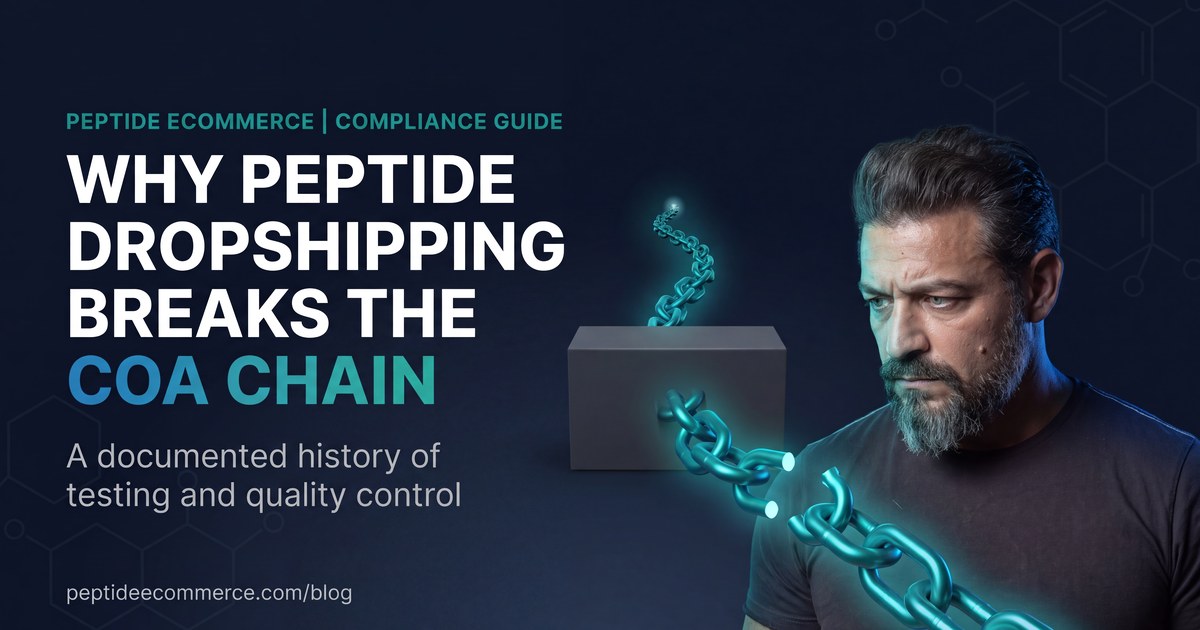
The Certificate of Analysis (COA) chain is a critical component of the peptide supply chain, serving as a documented history of testing and quality control for each batch of peptides. This chain starts at the manufacturer and ideally ends with the end-user, providing a transparent record of the peptide's identity, purity, and potency. For operators in the peptide ecommerce space, maintaining an unbroken COA chain is not just a matter of quality assurance, it's a regulatory necessity. When a business engages in peptide dropshipping, this chain is inherently broken, creating significant compliance risks and undermining the integrity of the product. Understanding why this happens and how it impacts your business is essential for maintaining regulatory compliance and building trust with your customers.
What is a Certificate of Analysis?
A Certificate of Analysis (COA) is a document provided by a manufacturer or supplier that details the specifications and test results for a specific batch of product. For peptides, a COA typically includes information such as:
| Element | Description |
|---|---|
| Batch Number | Unique identifier for the batch |
| Product Name | Specific peptide and its sequence |
| Appearance | Physical description of the product |
| Purity | Percentage of the peptide in the batch |
| Identity Test | Confirmation of the peptide sequence |
| Potency | Biological activity, if applicable |
| Testing Method | Procedures used for testing |
| Date of Analysis | When the tests were conducted |
The COA serves as a quality control tool, ensuring that the product meets the manufacturer's specifications and industry standards. It is a critical piece of documentation that operators must be able to provide upon request, especially if faced with regulatory inquiries or customer concerns.
Why the COA Chain Matters
The COA chain is a series of connected COAs that trace the journey of a peptide from its production to its final destination. Each link in the chain represents a transfer of custody, with each party in the chain being responsible for maintaining the integrity of the documentation. This chain is essential for several reasons:
- Regulatory Compliance: Agencies like the FDA require detailed records for products, especially those that could be misused or are subject to specific regulations. An unbroken COA chain provides the necessary documentation to demonstrate compliance with these requirements.
- Quality Assurance: The COA chain ensures that each batch of peptides meets the same high standards of quality and purity. This consistency is crucial for research and experimental purposes where reliability is paramount.
- Traceability: In the event of a product recall or quality issue, an intact COA chain allows for quick identification of affected batches and efficient containment of the problem.
- Customer Trust: Operators who can provide a complete COA chain demonstrate transparency and accountability, which can enhance customer trust and confidence in the product.
How Dropshipping Disrupts the COA Chain
Dropshipping is a business model where the retailer does not keep products in stock but instead passes orders to a third-party supplier, which then ships the products directly to the customer. While this model can be efficient and cost-effective, it poses significant challenges to maintaining an unbroken COA chain for peptides.
The Mechanics of Peptide Dropshipping
In a typical peptide dropshipping arrangement, the operator (the online retailer) receives an order from a customer. The operator then forwards the order to a supplier who holds the inventory. The supplier picks, packs, and ships the peptide directly to the customer, often without the operator's direct involvement in the fulfillment process. This model can be appealing due to its low overhead and the ability to offer a wide range of products without holding inventory.
However, this process creates a disconnect between the operator and the final product. The operator may not have direct access to the COA for the specific batch of peptide that is being shipped, nor may they have control over how the supplier handles and documents the product. This lack of control is where the COA chain is broken.
The COA Chain Break: A Detailed Look
The COA chain is broken in dropshipping scenarios for several reasons:
- Lack of Direct Access to COAs: Operators who dropship peptides often do not receive COAs directly from the manufacturer. Instead, they may rely on the supplier to provide these documents, if at all. This indirect relationship means that operators cannot verify the authenticity or accuracy of the COAs they receive.
- Supplier Handling of Documentation: Suppliers may not handle COAs with the same level of care and attention as the manufacturer. They might not store COAs securely, might not associate them correctly with specific batches, or might not maintain them in a way that allows for easy retrieval and verification.
- Inconsistent Documentation Practices: Different suppliers may have varying levels of compliance with documentation standards. An operator using multiple dropshipping partners may find it challenging to ensure that each supplier adheres to the same rigorous COA chain requirements.
- Regulatory Scrutiny: If an operator cannot provide a complete COA chain upon request from a regulatory agency, it could face significant penalties, including warning letters, fines, or even shutdowns. The lack of direct control in a dropshipping model makes it difficult to guarantee that the COA chain remains intact.
Regulatory Risks of a Broken COA Chain
Operators must understand the potential regulatory consequences of a broken COA chain. Regulatory agencies like the FDA have the authority to inspect facilities, review records, and take enforcement actions against businesses that fail to comply with regulations.
FDA Compliance and Enforcement
The FDA has issued numerous warning letters to businesses that fail to meet their obligations regarding product documentation and quality control. While these letters often address issues beyond the COA chain, the principle remains the same: maintaining proper documentation is a cornerstone of regulatory compliance.
For peptide ecommerce operators, the FDA's expectations regarding COAs are clear. The agency expects businesses to be able to provide documentation that verifies the identity, strength, quality, and purity of the products they sell. A broken COA chain makes it impossible to meet these expectations, leaving operators vulnerable to enforcement actions.
FTC Advertising and Marketing Standards
In addition to FDA regulations, operators must also consider the guidelines set forth by the Federal Trade Commission (FTC). The FTC requires that businesses do not make false or misleading claims about their products and that any representations about quality or purity are truthful and substantiated.
A broken COA chain can undermine an operator's ability to substantiate claims about product quality. If an operator cannot provide evidence of a product's purity or identity, they may inadvertently make claims that cannot be supported, leading to FTC scrutiny.
Maintaining Compliance Without Dropshipping
Given the risks associated with dropshipping and the importance of an unbroken COA chain, operators must consider alternative business models that allow for greater control over the supply chain and documentation.
Direct Supplier Relationships
Establishing direct relationships with peptide manufacturers or distributors can help operators maintain a complete COA chain. By working directly with suppliers, operators can:
- Receive COAs directly from the source, ensuring their authenticity and accuracy.
- Have greater visibility into the manufacturing and testing processes.
- Build stronger relationships with suppliers, fostering a culture of compliance and quality.
In-House Inventory Management
Holding inventory in-house allows operators to maintain direct control over the product and its documentation. This model enables operators to:
- Store and manage COAs securely, ensuring they are readily available when needed.
- Conduct additional quality control checks, if necessary, to supplement the manufacturer's testing.
- Respond quickly to regulatory inquiries or customer requests for documentation.
Third-Party Logistics with Oversight
For operators who prefer not to hold inventory directly, third-party logistics (3PL) providers can offer a middle ground. By selecting a 3PL that specializes in pharmaceutical or high-value products, operators can:
- Ensure that COAs are handled and stored according to industry standards.
- Maintain visibility into the inventory and documentation through regular audits and reporting.
- Leverage the expertise of the 3PL to navigate complex regulatory requirements.
Building a Robust COA Chain
Regardless of the business model chosen, operators must take proactive steps to build and maintain a robust COA chain. This involves implementing systems and processes that ensure the integrity of documentation at every stage of the supply chain.
Document Management Systems
Investing in a document management system can help operators organize and store COAs securely. These systems can:
- Provide a centralized repository for all COAs, making them easy to access and retrieve.
- Ensure that COAs are associated with the correct batches and products.
- Facilitate audits and compliance checks by maintaining an audit trail of all documentation activities.
Supplier Qualification and Auditing
Operators should establish rigorous supplier qualification processes to ensure that all partners meet their documentation and quality control standards. This includes:
- Conducting thorough due diligence on potential suppliers, including reviewing their quality systems and documentation practices.
- Performing regular audits of suppliers to verify that they continue to meet the required standards.
- Maintaining written agreements with suppliers that outline expectations for documentation and quality control.
Training and Education
Ensuring that all staff members understand the importance of the COA chain and their role in maintaining it is crucial. Operators should provide training and education on:
- The regulatory requirements for product documentation.
- The procedures for handling, storing, and retrieving COAs.
- The consequences of a broken COA chain and the steps to prevent it.
Navigating the Challenges of Peptide Dropshipping
While dropshipping may seem like an attractive option for peptide ecommerce operators, the risks associated with a broken COA chain cannot be ignored. The challenges of maintaining compliance, ensuring product quality, and managing regulatory scrutiny are significant.
Evaluating the Risks
Operators considering dropshipping should carefully evaluate the potential risks and weigh them against the benefits. This evaluation should include:
- An assessment of the supplier's documentation practices and their ability to maintain an unbroken COA chain.
- An analysis of the regulatory environment and the likelihood of scrutiny from agencies like the FDA and FTC.
- A review of the business's own capacity to manage and verify documentation in a dropshipping model.
Alternative Strategies
For operators who decide that the risks of dropshipping are too high, there are alternative strategies that can help maintain compliance while still offering a wide range of products. These strategies include:
- Curated Suppliers: Working with a select group of suppliers who meet stringent documentation and quality control standards.
- Private Labeling: Partnering with manufacturers to create private-label peptides, which allows for greater control over the supply chain and documentation.
- Hybrid Models: Combining elements of dropshipping with in-house inventory management to strike a balance between control and efficiency.
Compliance as a Competitive Advantage
Ultimately, maintaining a robust COA chain is not just about avoiding regulatory issues, it's about building a business that stands out for its commitment to quality and compliance. Operators who prioritize these aspects can differentiate themselves in the market, build customer trust, and create a sustainable business model.
The decision to engage in peptide dropshipping should not be taken lightly. The inherent risks to the COA chain can have far-reaching consequences for an operator's business, from regulatory penalties to reputational damage. By understanding these risks and taking proactive steps to maintain compliance, operators can build a business that is not only successful but also resilient in the face of regulatory scrutiny.
Maintaining an unbroken COA chain is an operator's obligation. It requires diligence, attention to detail, and a commitment to quality that extends throughout the entire supply chain. For those who embrace this responsibility, the rewards are a business that operates with integrity, builds trust with customers, and stands the test of time in a competitive market.
Frequently Asked Questions
Can I still sell peptides if I use dropshipping?
Yes, you can sell peptides using dropshipping, but you must be aware of the risks to the COA chain and take steps to mitigate them. This includes carefully vetting your suppliers, maintaining direct access to COAs, and ensuring that your business practices comply with all relevant regulations. Failure to do so could result in regulatory action and damage to your business's reputation.
How do I verify the authenticity of a COA if I'm using dropshipping?
Verifying the authenticity of a COA in a dropshipping model can be challenging. One approach is to request COAs directly from the manufacturer, even if you are using a dropshipping supplier. Additionally, you can conduct audits of your suppliers to ensure they maintain proper documentation practices. It's also advisable to use suppliers who are transparent about their testing and quality control processes.
What are the consequences of not having a complete COA chain?
Not having a complete COA chain can lead to significant consequences, including regulatory penalties, fines, and even the shutdown of your business. It can also damage your reputation and erode customer trust. Additionally, if a product issue arises, such as a recall or quality problem, a broken COA chain can make it difficult to identify and address the problem efficiently.
Are there any dropshipping suppliers that can maintain a COA chain?
While some dropshipping suppliers may claim to maintain a COA chain, it is rare for them to do so effectively. The nature of dropshipping makes it difficult to ensure that COAs are handled and stored correctly throughout the supply chain. Operators should be cautious when relying on dropshipping suppliers for products that require strict documentation and quality control, such as peptides. Instead, consider alternative business models that allow for greater control over the supply chain and documentation.
Considering outside help? Questions to ask before choosing a peptide business coach